
The Error We Continually Ignore
‘fallacy of misplaced concreteness.’

The Error We Continually Ignore
by Beezone
This essay is dedicated to my Philosophy professor at the University of New Orleans.

“purveyor of half-truths, dubious assertions, and outright lies”
Donald K. Hanks, d. 2014
***
Monades non sunt in loco nisi per harmoniam, id est per consensum com phaneomenis loci, a nullo influxu sed sponte rerum ortum
Gottfried Wilhelm Leibniz
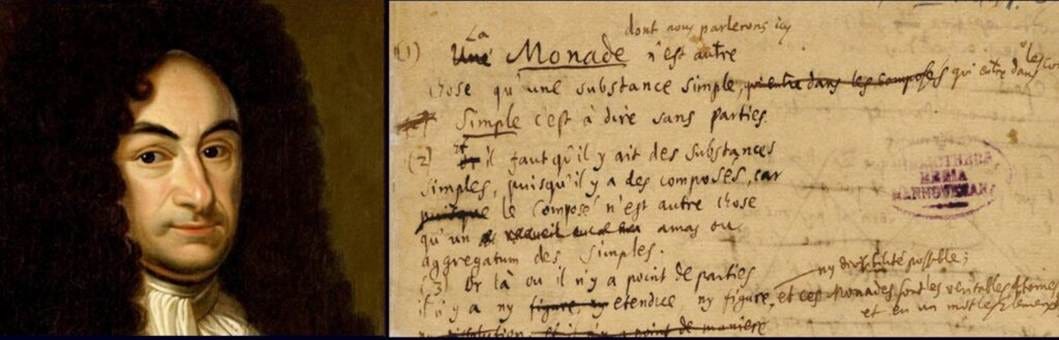
“Monadology” from 1714 was written in French and written while Leibniz stayed in Vienna
The purpose of this essay is not to argue with Gottfried Wilhelm Leibniz nor naively try to diminish the extraordinary achievements of Western philosophy. Leibniz stands among the greatest representatives of the rational tradition. His contributions to metaphysics, logic, binary arithmetic, and symbolic reasoning helped shape the intellectual foundations of the modern world. His vision of a calculus of reasoning—a method by which disputes might ultimately be resolved through formal analysis—anticipated developments that now lie at the heart of mathematics, computer science, and artificial intelligence.
My inquiry is not about whether abstract thought can be useful for representing reality. That much is granted almost as soon as it is stated — Whitehead named it directly, calling it the fallacy of misplaced concreteness (which will be discussed later in this essay).
The danger in naming ‘things’ is not in the in the name but in treating the name as the ‘thing’ itself. The word ‘fish’ is not a ‘fish’. The person’s name “Mary”, not “Mary.”
The dialogue that follows began with the opening paragraph of Leibniz’s The Distinction Between Mind and Body. What first appeared to be a discussion of mind and body gradually revealed itself to be something more fundamental—a discussion about philosophical method, and beneath that, about the limits of any method to secure the ground it claims to stand on.
[caption id=”attachment_65010” align=”aligncenter” width=”896”]
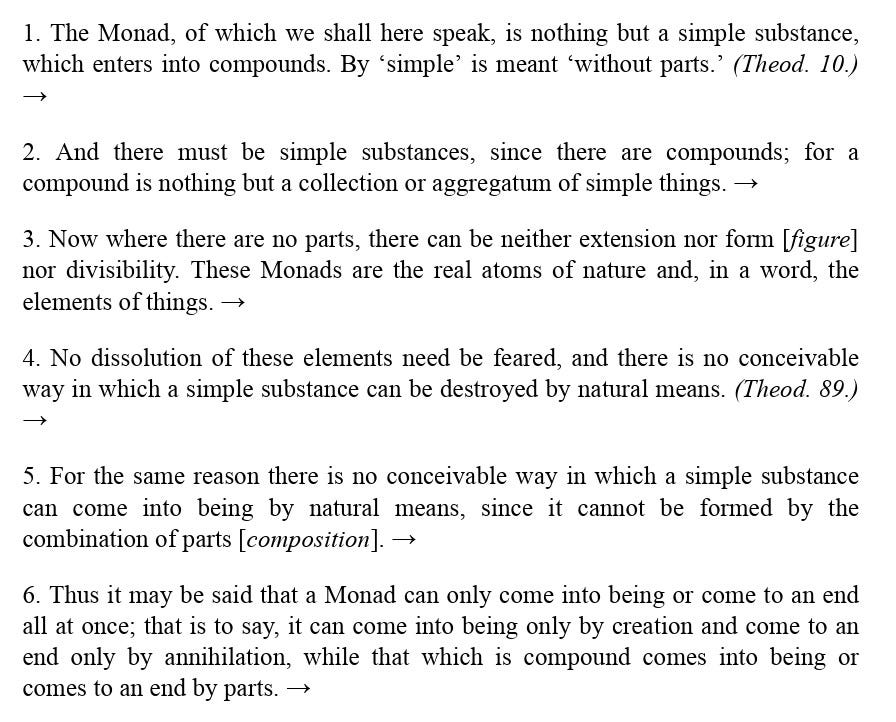
The Monadology by Gottfried Wilhelm Leibniz, English translation by Robert Latta, 1898
Leibniz begins with the familiar notion of the body. Yet almost immediately, the discussion moves from the concrete body to the abstract concepts of extension, substance, and mode. Such a movement is not, in itself, objectionable. Every science and every philosophy must abstract from particular experience in order to discover general principles. Abstraction is one of humanity’s greatest intellectual achievements.
The question is whether abstraction fulfills its task by returning to the concrete reality from which it began — and whether that return, even at its most careful, can ever be certified complete.
The critique developed here argues that Leibniz’s analysis does not complete that return. The body serves as the starting point of inquiry, but once abstract categories are introduced, they gradually become the primary objects of investigation. The discussion proceeds within the logical relations among concepts rather than continually testing those concepts against the actuality from which they were derived; the body.
This observation does not imply that Leibniz’s reasoning is logically invalid. On the contrary, the argument often possesses remarkable internal coherence. The issue is whether internal coherence alone establishes correspondence with reality.
Throughout this essay, “actuality” refers provisionally to the concrete world as encountered in lived experience, while “abstraction” refers to the conceptual structures through which we seek to understand it. Abstraction refers to the conceptual structures by which the mind seeks to understand that world.
The critique presented here does not oppose these two. Abstraction is indispensable. Without it, there could be no science, no mathematics, no philosophy, and no technology.
The difficulty begins when abstraction is no longer treated as an instrument of inquiry but becomes the measure of reality itself.
Leibniz’s confidence in rational analysis exemplifies one of the defining characteristics of Western philosophy. Through conceptual distinction, logical analysis, and universal principles, reality becomes increasingly intelligible. The extraordinary success of this method encouraged the belief that conceptual understanding discloses reality itself.
This dialogue questions that conclusion.
A concept is not the phenomenon from which it is abstracted. The word “tree” is not a tree. Likewise, the concept of body is not the living body itself. Conceptual analysis may illuminate important aspects of reality without exhausting reality itself.
Newton Dropped an Apple, Leibniz Thought About Dropping It
Leibniz’s development of binary arithmetic and his vision of symbolic reasoning proved foundational for much of the logical architecture underlying the digital age. Together with Newton’s mathematical formulation of physical law, these achievements helped establish one of the central assumptions of modern civilization: that reality is fundamentally accessible through formal reasoning and mathematical structure.
There can be little doubt that this methodology has transformed human civilization. Calculus made modern physics possible. Mathematical reasoning made modern engineering possible. Formal logic contributed to computation, and binary arithmetic became one of the foundations of digital technology.
None of this is questioned. What is questioned is a philosophical inference that often follows from such success. The extraordinary effectiveness of mathematics does not necessarily demonstrate that reality is itself mathematical. It demonstrates that mathematics is an extraordinarily powerful means of representing certain aspects of reality. The distinction is crucial.
Calculus can place a spacecraft on the Moon with astonishing precision. Algorithms can perform billions of calculations in seconds. Formal logic can demonstrate the validity of an argument.
Yet none of these methods, by themselves, can determine whether a marriage should end, whether forgiveness ought to be offered, or what constitutes wisdom. The temptation to overreach is not incidental to the method’s success. It is produced by it.
Abstraction delivers mastery. It predicts, calculates, controls, and builds. Actuality, by contrast, offers no such reward. It cannot be mastered, only met — with judgment, with patience, with the tolerance of what remains unresolved. Given a choice between the two, unexamined, a civilization will reliably choose mastery. Not because mastery is false, but because it pays.
This is why the error is not merely made but continually ignored. It is not simply that abstraction is mistaken for reality by accident, the way a map might be misread in poor light. The mistake is sustained, because giving it up costs something real — the confidence, the control, the goodies that mastery provides. Power aligns naturally with the systems that deliver these goods, and power, once aligned, has little incentive to ask whether the system it depends on has quietly replaced the reality it was built to serve.
But even where the temptation of mastery is absent — even for the philosopher sincerely trying to correct abstraction against actuality, seeking no power and no advantage — the error persists in a second, harder form. The very tool available for correction is itself conceptual. There is no way to check a concept against actuality except through further discernment, further judgment, further concepts about what counts as fidelity to the concrete. The return to actuality is real work, and worth doing. But it cannot be completed and certified, because the one thing that could certify it — a final, unmediated encounter with actuality itself, free of all conceptual structuring — is not available to a mind that knows anything at all.
So the error is ignored twice over: once because it is profitable to ignore it, and once because it cannot, even by the most careful and disinterested mind, be finally escaped. This is not a failure of mathematics or logic. It is a misunderstanding of their scope. Every method possesses a domain within which it achieves remarkable precision. Difficulty arises only when the success of that method encourages the belief that its domain constitutes the whole of reality.
The dialogue therefore, proposes a different methodological principle. Abstraction should always remain accountable to the actuality from which it arose. Philosophy may legitimately universalize the particular, but it should never lose sight of the particular in favor of its own conceptual constructions. A philosophical system that cannot return to illuminate the reality from which it began risks explaining its own categories more successfully than the world those categories were intended to explain.
This critique is therefore not directed solely toward Leibniz.
Leibniz serves as one of the clearest representatives of a broader tradition within Western thought—a tradition that has achieved extraordinary intellectual success through abstraction, logical distinction, and formal analysis.
The purpose of this essay is not to reject that tradition but to examine one of its possible limitations.
Reason remains one of humanity’s greatest achievements. But reason itself is an instrument. An instrument answers to something beyond itself. That is what accountability means.
Alfred North Whitehead named the danger precisely: the fallacy of misplaced concreteness — mistaking the abstraction for the actuality from which it was drawn.
In its turn every philosophy will suffer a deposition. But the bundle of philosophic systems expresses a variety of general truths about the universe, awaiting co-ordination and assignment of their various spheres of validity. Such progress in co-ordination is provided by the advance of philosophy; and in this sense philosophy has advanced from Plato onwards. According to this account of the achievement of rationalism, the chief error in philosophy is overstatement. The aim at generalization is sound, but the estimate of success is exaggerated. There are two main forms of such overstatement. One form is what I have termed elsewhere,2 the ‘fallacy of misplaced concreteness.’ This fallacy consists in neglecting the degree of abstraction involved when an actual entity is considered merely so far as it exemplifies certain categories of thought. There are aspects of actualities which are simply ignored so long as we restrict thought to these categories. Thus the success of a philosophy is to be measured by its comparative avoidance of this fallacy, when thought is restricted within its categories.
Alfred North Whitehead, 1932
Alfred North Whitehead, Process and Reality, p. 10
The corrective seems clear enough. Return to actuality. Test the concept against the concrete. But what is “actuality,” finally? Here the inquiry meets its own limit.

Nāgārjuna, c. 150, philosopher and Mahāyāna Buddhist monk from South India
Nāgārjuna will not let “actuality” stand as a final resting place. Even that word — even the distinction between the concrete and the abstract — is itself a construction, dependently arisen, empty of the fixed ground we ask it to provide. The corrective to abstraction is not another abstraction, however well disguised as its opposite.
This is not a contradiction to be resolved. It is a tension to be held. At one level — call it, with the tradition, the conventional — the distinction between actuality and abstraction does real work. It is how science corrects itself. It is how law remains answerable to justice rather than merely to precedent. It is how a philosopher notices when his own system has begun explaining itself more successfully than the world.
At another level — call it the ultimate — even that distinction dissolves. There is no secured territory behind the map, waiting to certify it. There is only the noticing.
I do not offer this as evasion. I offer it as the most honest place the inquiry can arrive. Fifty years of asking how we know reality — through Western philosophy, through Buddhist philosophy, through meditation, through what mind-expanding chemistry disclosed and then, inevitably, withdrew again into silence — have not produced a final answer. They were never going to. What they produced instead was a discipline: the capacity to notice, again and again, the moment when a map begins to be mistaken for the territory it was drawn to serve.
That noticing cannot be completed. It cannot be certified. It can only be practiced. The enduring task of philosophy, then, is not to finally reach the actuality behind our concepts. It is to keep asking, without end and without final answer, whether our abstractions remain faithful to the living reality from which they first emerged — and to hold, honestly, that the asking may be the only faithfulness available to us.