
The West’s First Self-Proclaimed Avatar
“You Are the Buddha”: Mani in the Lands of Turan

The West’s First Self-Proclaimed Avatar
“You Are the Buddha”: Mani in the Lands of Turan*
Ed Reither, Beezone
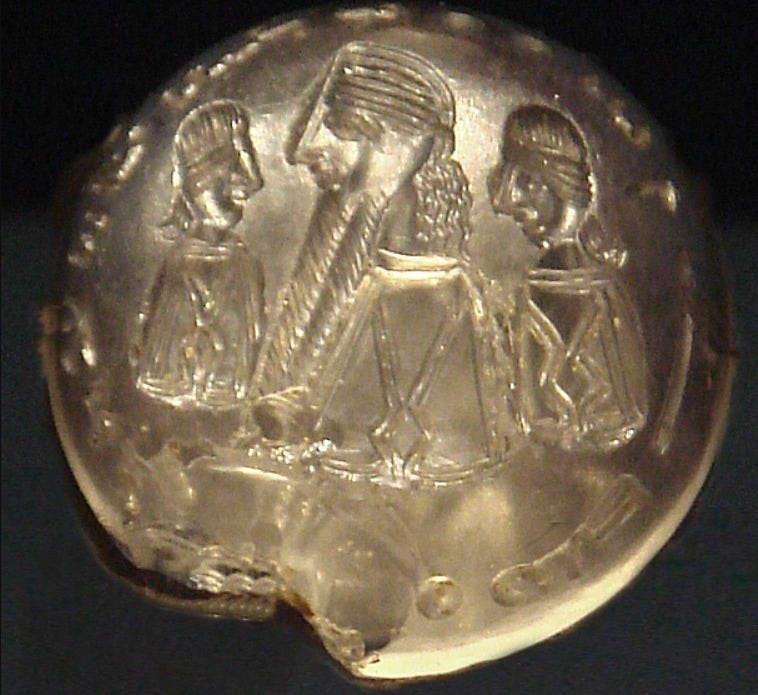
Seal of Mani (cleaned up). Seal with figure of Mani, possibly 3rd century CE, possibly Irak. Cabinet des Médailles, Paris
Note: The Term “Avatar”
The use of the term avatar in this essay is not meant to import the full cosmic structure of Hinduism into a Western context, but to point toward a particular kind of claim: not merely the transmission of a teaching, but its embodiment in a single figure—as a world event.
Whereas Mani brings India**—and, through the later spread of his teaching, even China—into view as part of a single world, a distinctly Eastern dimension enters the Western lexicon. What had once remained implicit or distant is now drawn into relation, not as something observed, but as something to be integrated.
Only much later does this same world come to be spoken of as divided—captured in the familiar line from Rudyard Kipling: “The East is East and the West is West, and never the twain shall meet.”
*“Turan” designates regions of Central Asia beyond the Iranian world which, by the 2nd–3rd centuries CE, were already within the sphere of Buddhist cultural influence extending from Gandhara.
**The term “India” is used here not as a fixed geographical boundary, but as a layered cultural field, including Bharat and the adjacent Central Asian regions (Turan) where Indian religious traditions—particularly Buddhism—had already spread by the early centuries CE.
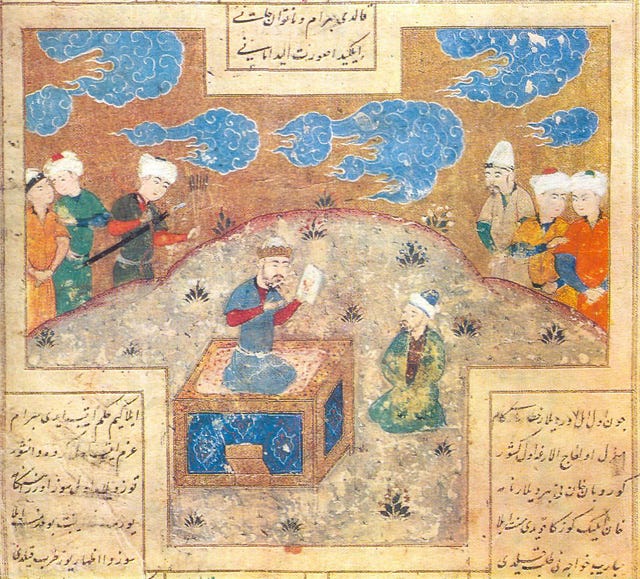
Sixteenth century painting by Ali Shir-Navai of Mani the painter presenting one of his drawings to Bahram Gur (Source: Voice of America).
Preface
In approaching the figure of Mani, one is immediately drawn into a world that does not resemble the simplified narratives we have inherited. The early centuries of the Common Era were not defined by a single religious vision, but by a dense and active field of exchange. Across Mesopotamia, Persia, and the Mediterranean, traditions we now name as Gnostic, Zoroastrian, Jewish, Christian, and Buddhist coexisted—not as isolated systems, but as overlapping and interacting ways of understanding reality.
Within this environment, ideas moved freely. Languages such as Greek and Aramaic carried concepts across regions; symbols and rituals appeared in multiple forms; and what later came to be defined as separate religions were, at that time, still in conversation. It is from within this shared field—not outside of it—that Mani emerges.
Mani does not present himself merely as a teacher among others. His claim is more comprehensive. He speaks as one who gathers what has already been given—reinterpreting earlier revelations and presenting them as parts of a larger whole. In Mani’s own understanding, the true religion had been disclosed in earlier times through figures such as Buddha, Zoroaster, and Jesus. Yet these revelations were incomplete, limited by place and time. Mani’s role was to bring them to fulfillment. He appears not merely as a teacher or apostle, but as the “seal of the prophets,” the Paraclete promised within the Christian tradition, and the final manifestation of a truth that had been only partially revealed before. What was local becomes, in his work, universal.
At the same time, another movement is taking shape to the west. With the rise of Constantine the Great and the eventual melding of Christianity with Roman imperial authority, a different response to this shared religious field begins to emerge. The plurality of voices does not disappear, but what had once been solely a field of debate becomes increasingly codified—a field not only of distinction, but also, at times, of destruction.
During this period, roughly 220–260 CE, give or take a few years, Mani’s life and the emerging Christian movements unfold in overlapping and layered directions. Where Mani seeks to bring multiple traditions into a single vision, the imperial form of Christianity moves toward a more fixed and universal formulation. The ancient and dispersed world that had long allowed debate now gives rise to politically supported and codified claims to truth.
In this context, the divisions of East and West begin to emerge. In the Roman West, Manichaeism and other Gnostic-type ideas are slowly but increasingly absorbed and reshaped into what only later can be identified as “Christianity.” In the East, beyond the direct reach of Roman imperial authority, a wide range of Gnostic, Persian, and Indian traditions continue. Here, some are translated, others adapted, and many carried along the routes of exchange into Central Asia and China.
Alongside these developments, the Hebrew tradition follows a different path. After the destruction of the Temple and the loss of a centralized homeland, continuity is maintained not through political alignment, but through text and interpretation. The tradition that develops does not attempt to resolve the inherent tensions of logic and duality into a single, coherent system, but instead sustains an ongoing process of dialogue. Multiple voices are not only allowed and fostered, but preserved, and understanding unfolds through a rich dialectic rather than through final answers to questions of right and wrong, good and evil, or truth and falsehood.
What emerges from this period, then, is not a single story, but several responses to the same historical condition. Mani represents one possibility: the attempt to gather and unify a dispersed field of meaning. The emerging Christian order represents another: the movement toward coherence and authority. The rabbinic tradition represents yet another: the preservation of plurality through interpretation.
This study does not attempt to resolve these trajectories into a final conclusion. Rather, it seeks to return to the conditions in which they first appeared—to a time before the narrative had settled—when what was possible had not yet been narrowed to what would later be remembered.
Prologue
To my surprise, I found the beginning at the end.
In the winter of 277 CE, after final trials, suffering, and execution, one of the most influential—and later largely forgotten—religious figures of the ancient world met the fate of many revelatory voices.
It was only much later—through the nineteenth-century writings of John Watson McCrindle—that I recognized in this figure something I had long intuited, but had not been able to locate with any historical clarity: a point at which the religious traditions of East and West were not merely in contact, but consciously brought into relation.
The man they escorted was Mani (Mani Ḥayyā)—prophet of Light. Mani does not present himself merely as an apostle of Jesus Christ, but as the one in whom that revelation is brought to completion. He had spent much of his life spreading a religious vision that could be heard across civilizations—from the Mediterranean world to Persia, and beyond to India, and even as far as China.
Continue reading »>
https://beezone.com/beezone-wop/mani.html